


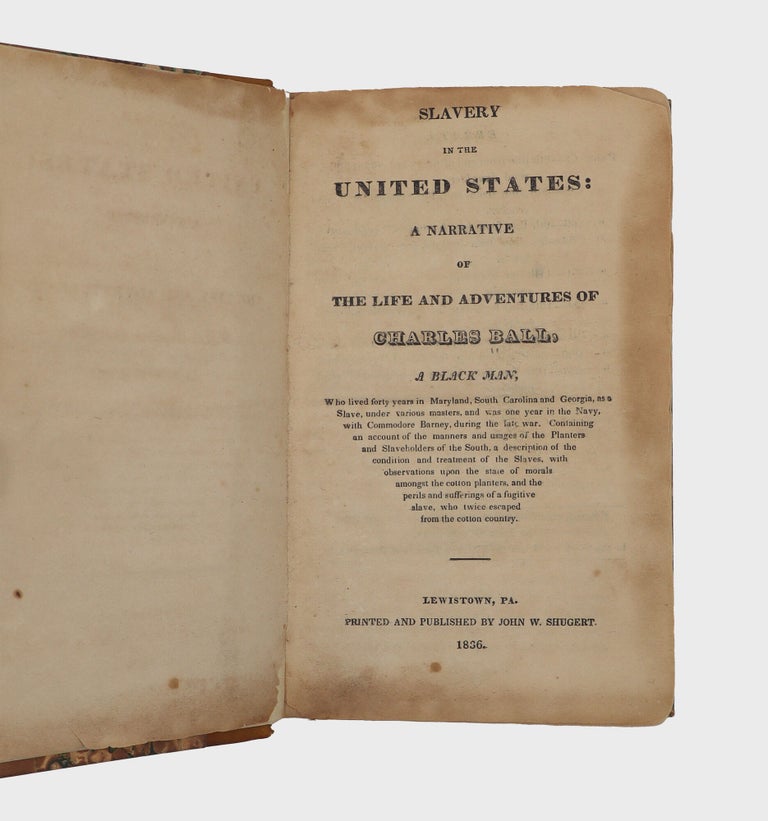

Rare First Edition of a Noted Slave Narrative
Slavery in the United States: The Narrative of the Life and Adventures of Charles Ball, a Black Man who lived forty years in Maryland, South Carolina and Georgia as a slave.
Lewistown, PA: John W. Shugert, 1836.
Price: $2,000.00
About the item
First edition. 400pp. 12mo. Modern quarter calf and marbled paper boards. Repairs to endpapers. Provenance: Kalozetean Literary Society (embossed stamps, ink numerical stamp on verso of title and first leaf). Lib. Co. of Philadelphia Afro-Americana 813; Work, pages 310-311.
Item #377809
Charles Ball was born into slavery in Maryland circa 1781 and subsequently separated from his family. He would later be hired out as a cook to the U.S.S Congress, and after his marriage and birth of a child would be separated again from his family and sold to a cotton planter in South Carolina and later to Georgia. After escaping from horrendous conditions in early 1810, he would serve in the U.S Navy in Commodore Joshua Barney's Chesapeake Bay Flotilla, only to be recaptured into slavery in Georgia. He escaped again and eventually made his way to Lewistown, Pennsylvania. In 1830 the town raised money to purchase his freedom from his former owner, who had tracked him down and sought to reclaim him as a fugitive slave.
Ball's autobiography, dictated to Isaac Fisher, was first published by subscription by a newspaper editor in Lewistown Pennsylvania in 1836, with a more widely-published edition printed in New York the following year. Republished again with significant changes and a new title, the work appeared as The Life of a Negro Slave in 1846; an abridged and more fanciful version was next published under the title Fifty Years in Chains in 1859. With each successive edition, the prose of the abolitionist movement and the sensationalism of commercial ventures dramatically changed the autobiography, making the first edition of the narrative particularly desirable as the true statement of Ball's original voice.
"On its first appearance, Slavery in the United States was issued by subscription by a small-town newspaper editor and had only limited circulation. It lacked the abolitionist rhetoric now considered a defining feature of the slave narrative. Only in 1837 was it picked up by New York abolitionists, who had it repackaged as an antislavery book and circulated through their information networks alongside other tracts such as Narrative of James Williams. Finally, Slavery in the United States was published in 1858 as Fifty Years in Chains by an opportunistic publisher who tapped into the new market for antislavery stories created by the resounding success of Harriet Beecher Stowe’s Uncle Tom’s Cabin (1852) ... All signs point to [the first edition being] a relatively private publication, destined mainly for a readership living near to Ball himself ... Thanks to the correspondence of Isaac Fisher it is now known that 3,000 copies were printed and sold in the 'village' (Fisher’s word) of Lewistown and in three Ohio counties ... very few copies of the first edition remain in circulation, compared with the number available of that of 1837 ... the publication of [the first edition] was the result of private planning outside the established circles of either the commercial publishing industry or the abolitionist movement ... Yet the ever wider readership of Charles Ball’s narrative [in the later editions] corresponded to the incremental loss of its substance. There occurred a gradual adulteration of what Ball’s oral testimony to Fisher in the mid1830s might be imagined to have contained. Publication under a commercial imprint in the post-Uncle Tom context only deepened this process of hollowing-out. What was left in the end was but a distant echo of the slave’s original, singular voice" (Michael Roy, The Vanishing Slave: Publishing the Narrative of Charles Ball" in Papers of the Bibliographical Society of America, 111:4 (2017): pp. 513–545).
