



The First Thorough American Survey of the Lower Mississippi, and One of the Earliest American Reports on West Florida
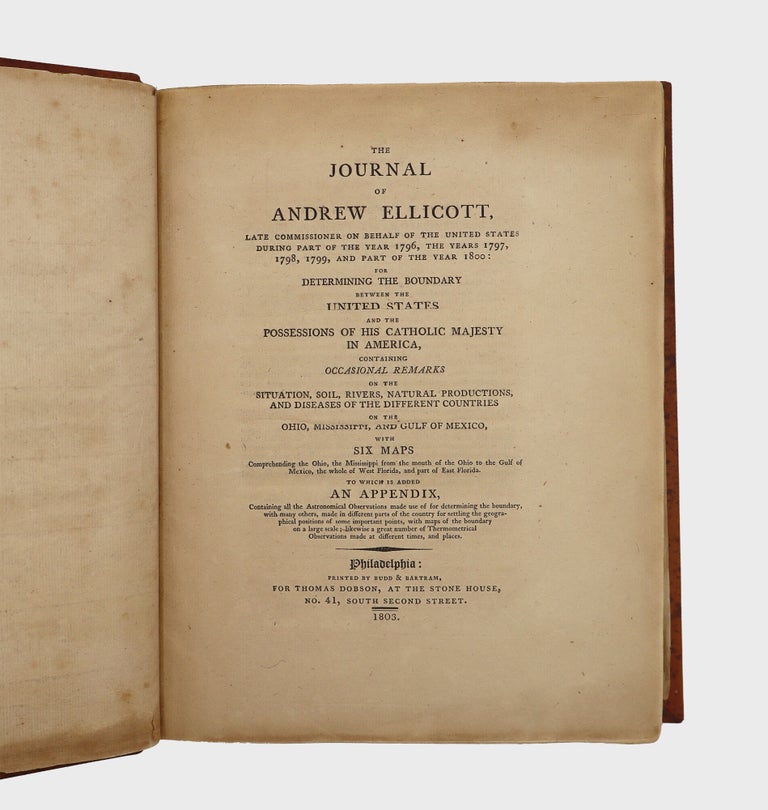
The Journal of Andrew Ellicott, Late Commissioner on behalf of the United States during part of the Year 1796, the Years 1797, 1798, 1799, and part of the year 1800: for Determining the Boundary of the United States and the Possessions of his Catholic Majesty in America, containing Occasional Remarks on the Situation, Soil, Rivers, Natural Productions, and Diseases of the Different Countries on the Ohio, Mississippi and Gulf of Mexico.
Philadelphia: Printed by Budd & Bartram, for Thomas Dobson, 1803.
Price: $6,500.00
About the item
First edition. Fourteen folding maps and charts. vii, [1, blank],[1]-232, 232*-299, 151, [3]pp. Errata in rear. 4to. Modern tree calf, raised bands ruled in gilt, morocco lettering piece. Toned throughout, repairs to separations at the folding maps. Clark II:89; Erickson et. al. Literature of the Lewis and Clark Expedition 1a.12 and 1b.3(v); Graff 1230; Howes E94; Reese, Federal Hundred 95; Sabin 22216; Streeter sale 1531.
Item #377791
At the end of the 18th century, Andrew Ellicott was one of the most experienced surveyors in the United States. Following the Revolution he had worked with David Rittenhouse and Bishop James Madison to extend the survey of the Mason-Dixon line through the Ohio country, what would become the old Northwest Territory. Ellicott was tasked, after Alexander Hamilton's Compromise of 1790 created a new U.S. capital, with accomplishing the surveys and laying out the plans for Washington, D.C. As the new nation grew, attention turned to its southernmost border. Thomas Pinckney's 1796 treaty with Spain defined that border between the United States and Spanish Florida, guaranteed United States navigation rights on the Mississippi River and ended the West Florida conflict. Among the terms of the treaty was the need for a new survey of the boundary, and Ellicott was appointed to that end by George Washington. He started his work in the winter of 1797 in Natchez, and his travels and surveys occupied four years, covering the Mississippi Valley, Florida and the southern hinterlands, concluding in Georgia in the spring of 1800.
The account of his survey was first published in 1803 to widespread acclaim, announced for sale in Philadelphia newspapers at the end of September of that year at $6 bound or $5 in boards. "The text provides a detailed summary of his work, while the fourteen maps show the border and the region in far more detail than they had been illustrated previously. It was the first thorough American survey of the lower Mississippi, and one of the earliest American investigations of West Florida. At the time of the Louisiana Purchase, this was one of the foremost authorities available on the region" (Reese).
Indeed Ellicott's work would be profoundly influential on the Lewis and Clark expedition, particularly to Meriwether Lewis who studied under Ellicott in preparation for the journey and based his astronomical and thermometrical observations on Ellicott's instruction. Erickson et. al. posit that a copy of the first edition was "probably carried on the expedition"; furthermore, the manuscript map of the west by Nicholas King used by Lewis and Clark on the expedition was based in part on Ellicott's survey, with Albert Gallatin writing to Thomas Jefferson on March 14, 1803, "In this [King's map] I intend to insert the course of the Mississippi as high up as the Ohio from Ellicott's [chart]"
