


Inscribed to his friend T.E. Lawrence, "Lawrence of Arabia"
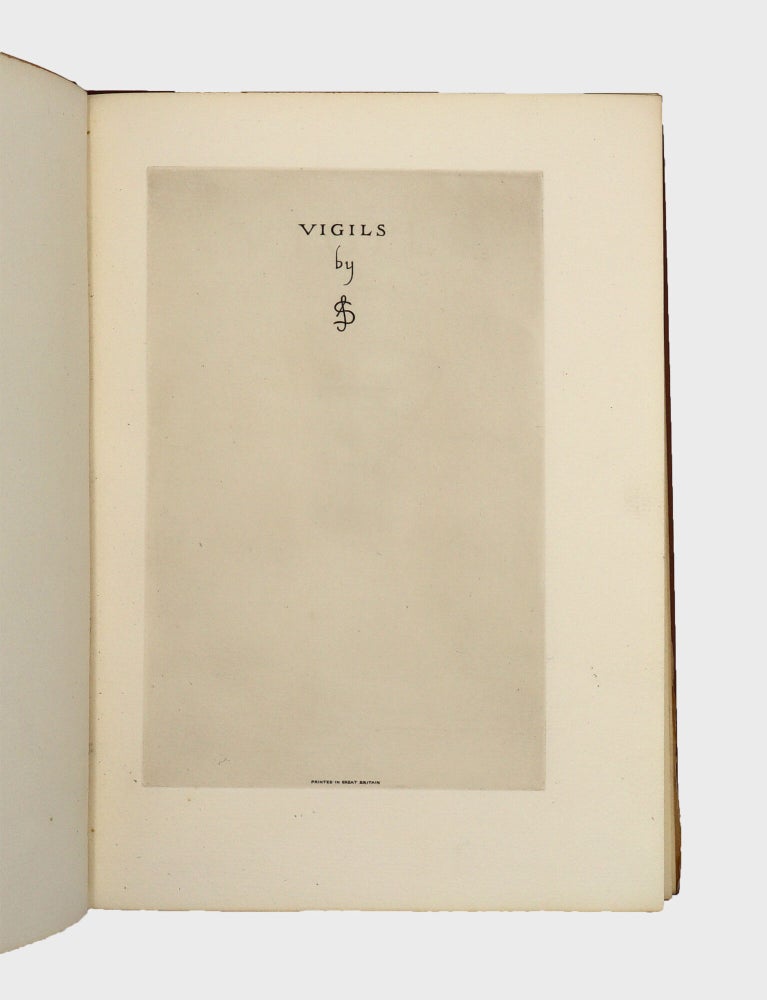
Vigils.
[Bristol: privately printed for Douglas Cleverdon], 1934.
Price: $17,500.00
About the item
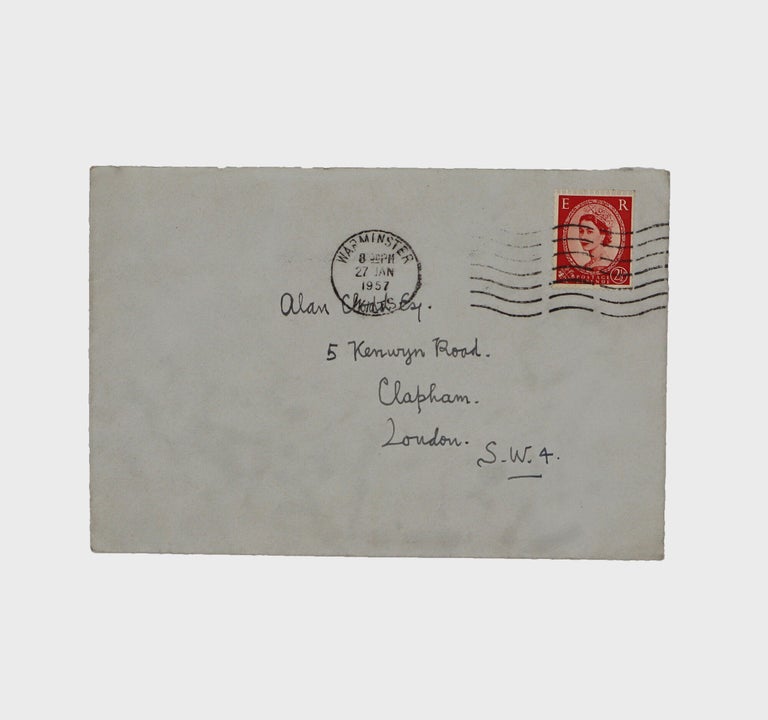
Gooden, Stephen. First edition, no. 255 of 272 copies, and one of 60 copies for presentation; inscribed by Sassoon on the first blank, and additionally signed on colophon; autograph list on his personal stationery tipped in at front, with autograph letter in franked autograph envelope loosely held at front. Title-page designed and engraved by Stephen Gooden, text engraved on copper by Charles Sigrist and printed in May 1934. 8vo. Quarter-bound rust and light brown boards, stamped in gilt on spine; light rubbing along spine edges; top edge gilt; high quality cotton paper; some light offsetting throughout. Near fine. Dodgson (Gooden) #103; Keynes A39.
Item #376444
Sassoon and Lawrence first became acquainted near the end of the First World War, and their ensuing 15-year friendship was marked by both mutual admiration and the vocal support of each other's literary endeavors. The two frequently addressed each in correspondence by their initials, a convention seen here in Sassoon's simple inscription to Lawrence on the first blank, "TE / Salutamus," which is signed not only by him with his personal "SS" cipher, but also with the initials of his wife, Hester Sassoon. (It is additionally fully signed and numbered by Sassoon on the colophon page at rear.) At his death, Lawrence owned thirteen copies of Sassoon's work (Aldington, Lawrence of Arabia: A Biographical Enquiry, p. 381).
Two additional items make this particular copy quite exceptional.
Tipped in at the inscription page is an autograph note in Sassoon's hand titled "Dates of 'Vigils' in order of arrangment in the book," which lists each poem sequentially by the month and year it was written, with the oldest being January 1927 and the latest March 1933. It is written on his personal Heytesbury House, Wiltshire, stationery — the house he moved to in 1933 — and finished with a stamp of his cipher in red ink at bottom.
This was likely in response to a letter Lawrence wrote Sassoon about Vigils on December 17, 1934: "They have deeply moved me.... To be read slowly and in sequence.... Sometimes, in a lyrical phrase or an adjective of accumulated beauty, I can link them to your earlier work: but only thus, externally, by a common ornament.... By their implications I date the first drafts of all of them from before that day at Christchurch, and I feel that you, yourself, have changed colour somewhat since the writing. You have more colour now, I think, and more colours too. But these are exquisite poems, exquisite." (Garnett (ed.), Letters of T. E. Lawrence, Jonathan Cape, 1938, pp. 834–6)
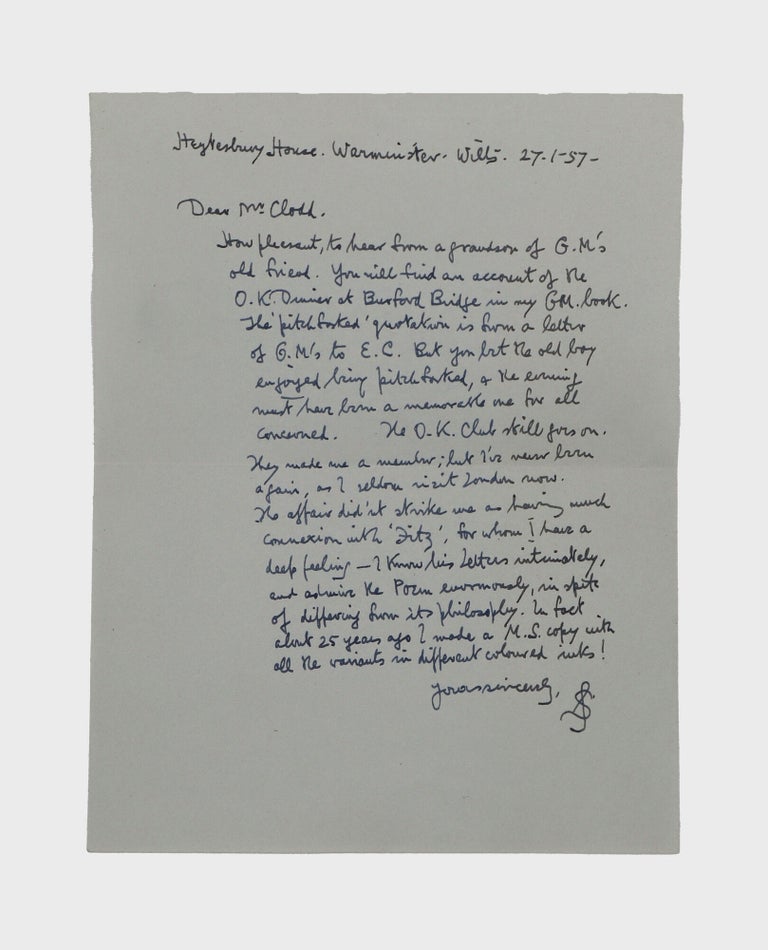
The second additional item — a January 27, 1957, autograph letter from Sassoon to the Irish publisher, book collector, and bookdealer Alan Clodd — contributes yet a third fascinating association to this unique edition.
Clodd, who over 50 years amassed a large collection of modern literature (including Sassoon), was also the grandson of the English banker, writer, and anthropologist Edward Clodd, who numbered among his many friends in the literary and scientific worlds Thomas Huxley, Herbert Spencer, Thomas Hardy, and George Meredith, the latter of whom was the subject of a biography written by Sassoon, and is mentioned here in Sassoon's response to a query from Clodd: "How pleasant to hear from a grandson of G.M.'s old friend. You'll find an account of the O.K. Dinner at Burford Bridge in my G.M. book. The 'pitchforked' quotation is from a letter of G.M.'s to E.C. But you bet teh old boy enjoyed being pitchforked, & the evening must have been a memorable one for all concerned."
The "O.K. Dinner" referenced by Sassoon was a meeting of the Omar Khayyám Club of London held in July 1895 at the Burford Bridge Hotel, at which Meredith (who lived nearby), Clodd, Hardy, Edmund Gosse, and others were in attendance. The Club was initially formed in 1892 to celebrate and honor Edward FitzGerald's enormously popular translation of the "Rubáiyát of Omar Khayyám," and it attracted a creative and literary membership, all of which Sassoon alludes to as he continues:
"The O.K. Club still goes on. They made me a member; but I've never been again, as I seldom visit London now. The affair didn't strike me a having much connection with 'Fitz,' for whom I have a deep feeling — I know his letters intimately, and admire the Poem enormously, in spite of differing from its philosophy. In fact, 25 years ago I made a M.S. copy with all the variants in different coloured inks!"
A wonderful piece of literary and cultural history.

