


Insider’s Account of the Centennial of the Seabury Ordination
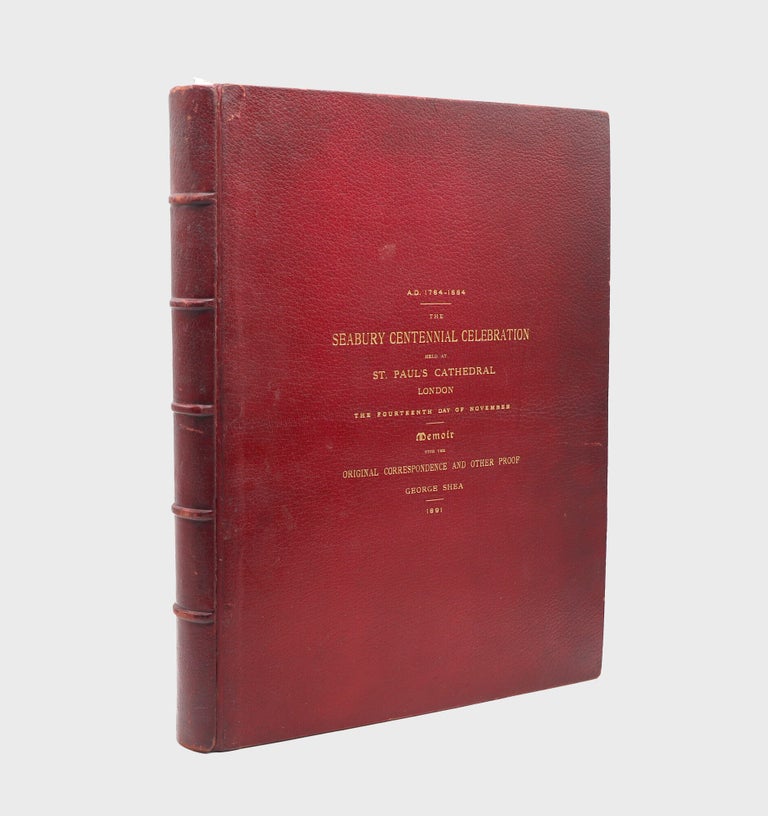
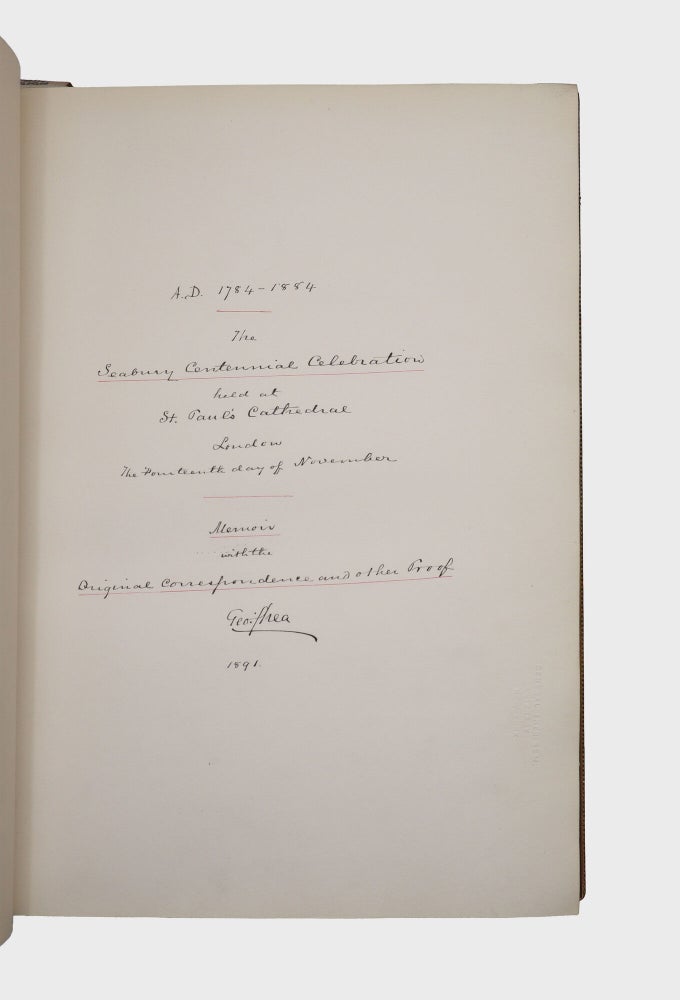
A.D. 1784-1884. The Seabury Centennial Held at St. Paul’s Cathedral London the Fourteenth Day of November. Memoir with the original Correspondence and other Proof.
[New York: 1892].
Price: $3,750.00
About the item
Manuscript in red and black ink on paper, with inlaid correspondence, printed leaves, and inserted facsimile broadside. Pp. 207, [208-221, blank]. 1 vols. Folio. Full red levant morocco gilt, red and green doublures gilt, silk flyleaves, a.e.g., by R.W. Smith. Some darkening to binding. Rebacked, preserving spine. Provenance: General Theological Seminary (bookplates).
Item #373590
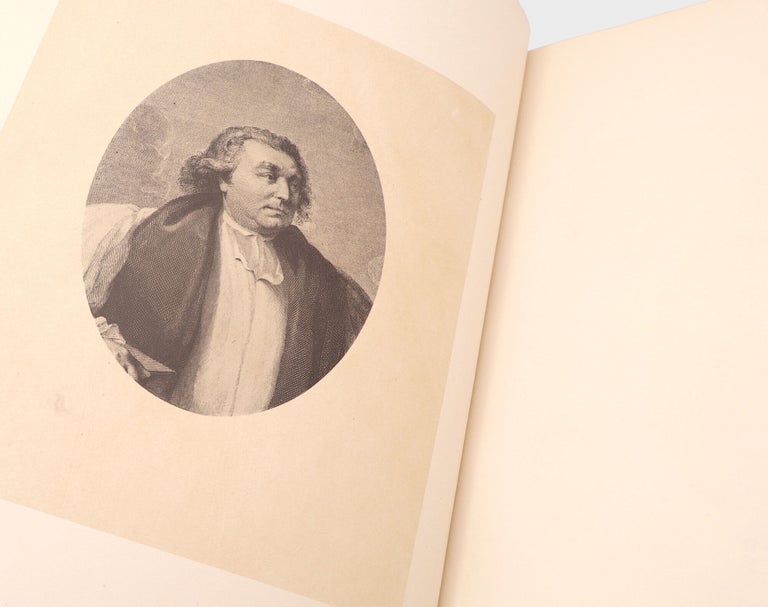
Samuel Seabury (1729–1796), first bishop of the Protestant Episcopal church in the United States of America, was born at Groton, Connecticut and attended Yale (Class of 1748). He intended to follow in his father’s footsteps as a missionary and studied in Edinburgh and was ordained by the Society for the Propagation of the Gospel in 1753. On his return to the American colonies he was “ was successively rector of New Brunswick, New Jersey, of Jamaica, of Long Island, and of Westchester, New York, where he served until 1776. [. . .] he was briefly imprisoned in 1775 by the revolutionary forces in Connecticut, following the publication of a series of pamphlets attacking patriot institutions including the continental congress. In a long letter to the SPG he reported that he had closed his church. ‘There would be neither prayer nor sermon’ until he could pray for George III, he wrote, while assuring the society (which paid him £50 a year) that he would not leave his mission ‘so long as it was practical to stay’” (ODNB).
Selected by a group of Connecticut clergymen to become the first bishop of the newly formed American episcopal church, Seabury travelled to Britain in 1783 to seek consecration. As an American citizen, he could not swear allegiance to the Crown, but nonjuring Scottish bishops proved willing to perform the ceremony after assurances were given that Britain had recognized the United States of America. He was consecrated bishop at Aberdeen on 14 November 1784. A Concordat was signed to acknowledge full communion between the episcopalians of Scotland and Connecticut; Seabury returned to New London, Connecticut in May 1785.
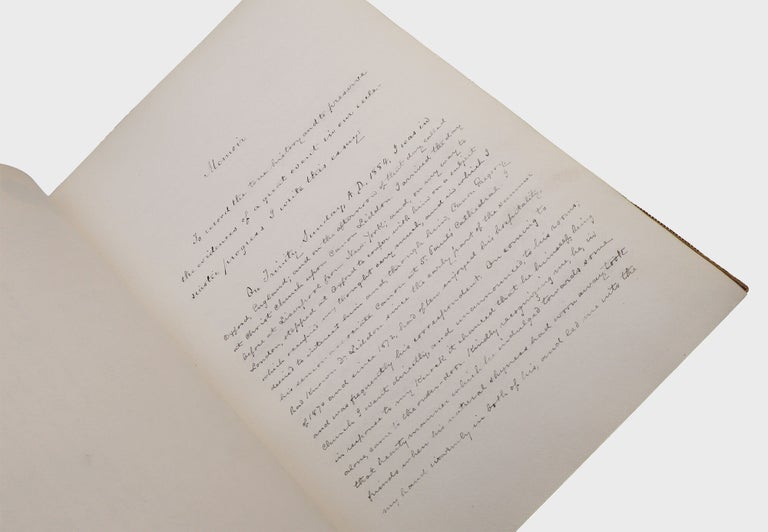
George Shea (1826-1895), born in Ireland, was one of the attorneys of Jefferson Davis, president of the Confederate States during the Civil War. He later became Chief Justice of the Marine Court of New York and was active in the Episcopal Church in New York City. This anecdotal memoir discusses Shea’s interest in commemorating Seabury’s consecration and his visits with clergymen at St. Paul’s in London, and preserves relevant correspondence (including reatined drafts and typed transcripts of Shea’s letters).
Contents of the volume:
A) “Memoir. To preserve the true history and to preserve the evidences of a great event in our ecclesiastic progress, I write this essay:” manuscript in black ink, signed and dated by George Shea, April, 1892, pp. 9-53.
B) Correspondence, pp. 55-138, comprising:
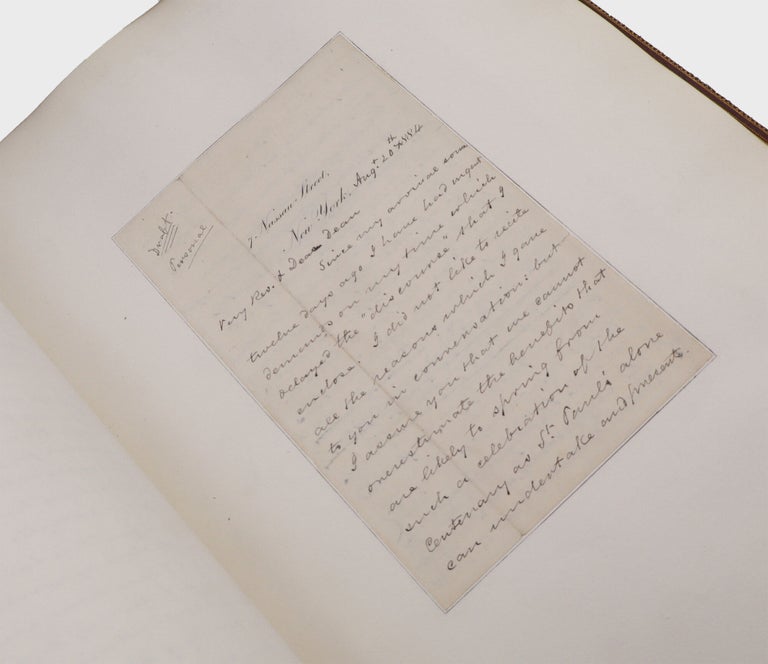
i) SHEA, G. A.L.s., to My very dear Dean [CHURCH], 20 Aug. 1884, marked Draft, 4 pp.
ii) SHEA, G. T.L.s., to My very dear Dean [CHURCH], 19 Aug. 1884, 14 pp., rectos only, signed at end
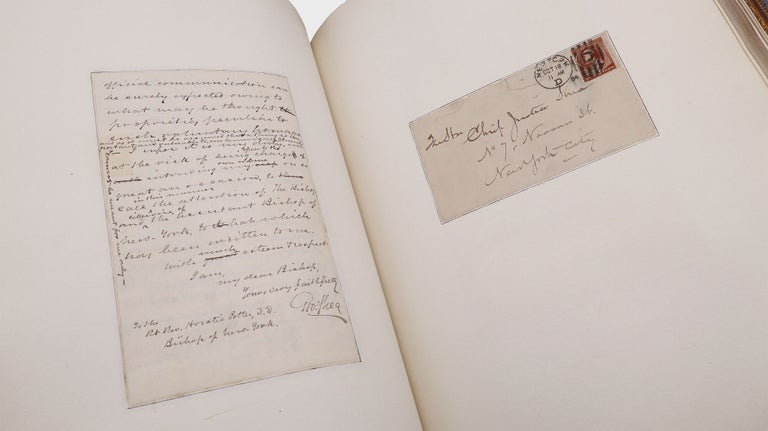
iii) CHURCH, R.W. A.L.s, dated The Deanery, 17 Sept. 1884, 2 ff., with cover addressed to Shea
iv) BENSON, Edward White, Archbishop of Canterbury. A.L.s. (“Edw.Cantab:”) to Dean [Church], Addington Park, Croydon, 12 Sept. 1884, 2 pp., agreeing to preach on the Seabury centenary
v) POTTER, Horatio, Bishop of New York, A.L.s., Newport, R.I., 30 Sept. 1884, 1 page
vi) SHEA, G., A.L.s., to Potter, 4 Oct. 4 pp.
vii) POTTER, H. A.L.s., Hobart College, Geneva, N.Y., 16 Oct. 1884, 3 pp., with cover
viii) LIDDON, Henry P. Cannon of St. Paul’s. A.L.s., Amen Court, St. Paul’s, 16 Oct. 1884, 3 pp., with cover
ix) SHEA, G. A.L.s., to Church, 31 Oct. 1884, marked Draft, 3 pp.
x) CHURCH, R.W. A.L.s, dated The Deanery, 4 Nov. 1884, 4 pp., with cover
xi) [Manuscript Order of Service] for the centenary, 1 page
xii) CHURCH, R.W. A.L.s, 2 ff., 15 Nov. 1884, account of the commemoration service
xiii) [Manuscript Account of the commemoration], 15 Nov. 1884, 4 pp.
xiv) LIDDON, Cannon. A.L.s, 28 Nov. 1884, 4 pp., with cover
D) Seabury Commenmoration, 1884. [4], 16 pp.; inlaid, pp. 139-59.
E) BENSON, Edward White. "Deep calleth unto deep". The Seabury commemoration. A sermon. London: Macmillan and Co., 1884. [2], 13 pp.; inlaid, pp. 161-78.
F) Correspondence, pp. 183-203, comprising:
i) WORDSWORTH, Charles, Bishop of St. Andrews. A.L.s., Bhishopshall, St. Andrews, 29 July 1884, 4 pp., with cover
ii) BRADLEY, A[rthur] Granville. Peterboro, Ontario, 24 Sept. 1884, 4 pp., with cover. “I have just heard from my father about Dr Seabury”
iii) BRADLEY, G. Bradley, Dean of Westminster. A.L.s., Deanery, Westminster, 4 Oct. 1884, 4 pp.with cover
G) Appendix, pp. 205-7: Seabury, William Jones. An Episcopal Chart by W.J. Seabury, 1882. (Printed facsimile broadside, tipped to p. 206).
