A Letter from Lawrence to a Doctor Recommended by George Bernard Shaw's Wife, Charlotte Payne-Townshend
Typed Letter Signed, "TE Shaw," to Dr. William Cooper.
Plymouth: November 7, 1930.
Price:
$6,500.00
1 page. 4to. One leaf cream paper, recto only, return address stamped in red at top, folded for mailing. Held within plain envelope with autograph notation in black ink.
Item #371188
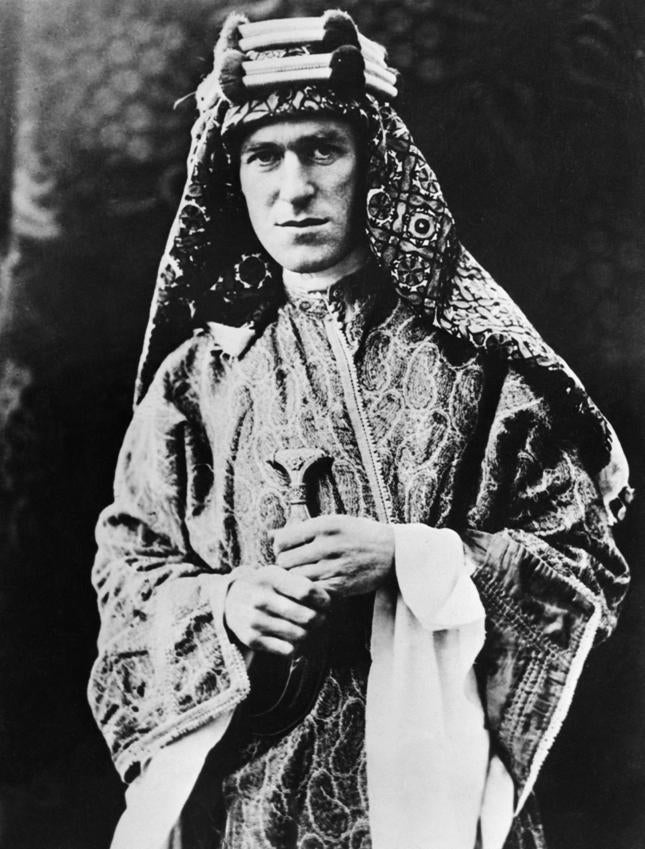
A typed letter from T. E. Lawrence — here signed "TE Shaw," the pseudonym he assumed upon reentering the military in the 1920s — to Dr. William Cooper, a physician who had examined his previously broken wrist in the hope of improving its range of motion.
As he writes in the note, he was brought to the doctor's office by "Mrs. Shaw"; however, this was not his wife — he never married — but that of playwright George Bernard Shaw, Charlotte Payne-Townshend Shaw: "I had wanted to say thank you for your examining me that morning. Mrs. Shaw and I thought of it on the spur of the moment, for we had been long studying ways and means of my getting it to you."
Lawrence had been close with the couple since 1922, when he first wrote to G. B. about his manuscript for The Seven Pillars of Wisdom. George subsequently assumed a near father-figure role with the nascent author, while Charlotte started working with Lawrence on the book, encouraging him in letters and suggesting edits and revisions. Biographer Ann Oakley noted in The Guardian, “She had this extraordinarily close intellectual relationship with Lawrence…. There is evidence she had a massive impact on Lawrence’s writings and was essential to the success of his work….” ("His fair lady: how George Bernard Shaw’s wife played a vital role in his masterworks," May 29, 2021). The relationship was such that he used their last name when he enlisted in the Royal Tank Corps in 1923, and continued using it after he transfered to the Royal Air Force in 1925.
Charlotte clearly had a previous association with Dr. Cooper, as evidenced by a September 1928 letter from her to Cynthia Curzon Mosely, the first wife of Oswald Mosely, in which she provided Cooper's contact information in Park Lane and suggested he offered "less conventional treatment." The reason for Lawrence's visit is explained in an autograph note Cooper wrote on the outside of the holding envelope: "Sent to me by Lawrence after I had examined his wrist which had been broken. Seeing two old people in difficulty with a car which wouldn't start, he offered to help them, but the handle of car on a back fire hit him on wrist & broke it." The accident had happened in 1926, and Lawrence's delay in treating it resulted in his not recovering full movement in his right hand.
While it appears Cooper was not able to effect much immediate relief four years later, Lawrence was nonetheless appreciative of the doctor's time and attention, writing, "What you said was most assuring; as it is not likely to get worse I snap my fingers at it. Half an arm is plenty for one's old age, and I have still an arm and a half. Nevertheless, if fate does bring me to London (No wise man would prophesy anything concerning me) I will attend on you solemnly and have even this little inconvenience chased out. It has been less painful since I came to you: but do not flatter your art — it is faith and happiness acting through a favourable judgement. Try telling a patient that she or he will get worse, and see it happen!"
He follows this by asking the doctor to let him know how much the consultation cost, explaining that "Before Mrs. Shaw I could not discuss finance; she would have felt herself liable for bringing me, whereas actually she did conver a benefit on me," adding, "My scandalous life of enjoyment is not to be justified, but palliated perhaps, by paying for itself." In a postscript, he references the debt is purely financial in nature, further noting, "Morally I am the assessor, and delighted."
Lawrence's humor is evident not only here, but throughout the one-page note, from his opening paragraph — "Dear Cooper was to presume a very short acquaintance. Dear Dr. Cooper lines you up with a class you probably detest. Dear Mr. Cooper is stiff. So let's begin again." — to his description of a somewhat long passage, stating that "Henry James was the putative parent of that last sentence."
Also present is an attestation of his enduring affection for Charlotte; accounting for the delay in corresponding with Cooper, he writes, "…I was detracked suddenly by the accident to Mrs. Shaw. I am so sorry about that, because she is not so long or quite completely recovered from a scarlet-fever incident at Buxton…. I had so wanted her to enjoy a quiet autumn and then to go away to some humane climate for the winter. Instead of which she bumps down in Hanover Square and will be tied by the leg for more weeks."
A warm letter with a fascinating back story, linking three literary and historical legends.
Item #371188
A typed letter from T. E. Lawrence — here signed "TE Shaw," the pseudonym he assumed upon reentering the military in the 1920s — to Dr. William Cooper, a physician who had examined his previously broken wrist in the hope of improving its range of motion.
As he writes in the note, he was brought to the doctor's office by "Mrs. Shaw"; however, this was not his wife — he never married — but that of playwright George Bernard Shaw, Charlotte Payne-Townshend Shaw: "I had wanted to say thank you for your examining me that morning. Mrs. Shaw and I thought of it on the spur of the moment, for we had been long studying ways and means of my getting it to you."
Lawrence had been close with the couple since 1922, when he first wrote to G. B. about his manuscript for The Seven Pillars of Wisdom. George subsequently assumed a near father-figure role with the nascent author, while Charlotte started working with Lawrence on the book, encouraging him in letters and suggesting edits and revisions. Biographer Ann Oakley noted in The Guardian, “She had this extraordinarily close intellectual relationship with Lawrence…. There is evidence she had a massive impact on Lawrence’s writings and was essential to the success of his work….” ("His fair lady: how George Bernard Shaw’s wife played a vital role in his masterworks," May 29, 2021). The relationship was such that he used their last name when he enlisted in the Royal Tank Corps in 1923, and continued using it after he transfered to the Royal Air Force in 1925.
Charlotte clearly had a previous association with Dr. Cooper, as evidenced by a September 1928 letter from her to Cynthia Curzon Mosely, the first wife of Oswald Mosely, in which she provided Cooper's contact information in Park Lane and suggested he offered "less conventional treatment." The reason for Lawrence's visit is explained in an autograph note Cooper wrote on the outside of the holding envelope: "Sent to me by Lawrence after I had examined his wrist which had been broken. Seeing two old people in difficulty with a car which wouldn't start, he offered to help them, but the handle of car on a back fire hit him on wrist & broke it." The accident had happened in 1926, and Lawrence's delay in treating it resulted in his not recovering full movement in his right hand.
While it appears Cooper was not able to effect much immediate relief four years later, Lawrence was nonetheless appreciative of the doctor's time and attention, writing, "What you said was most assuring; as it is not likely to get worse I snap my fingers at it. Half an arm is plenty for one's old age, and I have still an arm and a half. Nevertheless, if fate does bring me to London (No wise man would prophesy anything concerning me) I will attend on you solemnly and have even this little inconvenience chased out. It has been less painful since I came to you: but do not flatter your art — it is faith and happiness acting through a favourable judgement. Try telling a patient that she or he will get worse, and see it happen!"
He follows this by asking the doctor to let him know how much the consultation cost, explaining that "Before Mrs. Shaw I could not discuss finance; she would have felt herself liable for bringing me, whereas actually she did conver a benefit on me," adding, "My scandalous life of enjoyment is not to be justified, but palliated perhaps, by paying for itself." In a postscript, he references the debt is purely financial in nature, further noting, "Morally I am the assessor, and delighted."
Lawrence's humor is evident not only here, but throughout the one-page note, from his opening paragraph — "Dear Cooper was to presume a very short acquaintance. Dear Dr. Cooper lines you up with a class you probably detest. Dear Mr. Cooper is stiff. So let's begin again." — to his description of a somewhat long passage, stating that "Henry James was the putative parent of that last sentence."
Also present is an attestation of his enduring affection for Charlotte; accounting for the delay in corresponding with Cooper, he writes, "…I was detracked suddenly by the accident to Mrs. Shaw. I am so sorry about that, because she is not so long or quite completely recovered from a scarlet-fever incident at Buxton…. I had so wanted her to enjoy a quiet autumn and then to go away to some humane climate for the winter. Instead of which she bumps down in Hanover Square and will be tied by the leg for more weeks."
A warm letter with a fascinating back story, linking three literary and historical legends.