





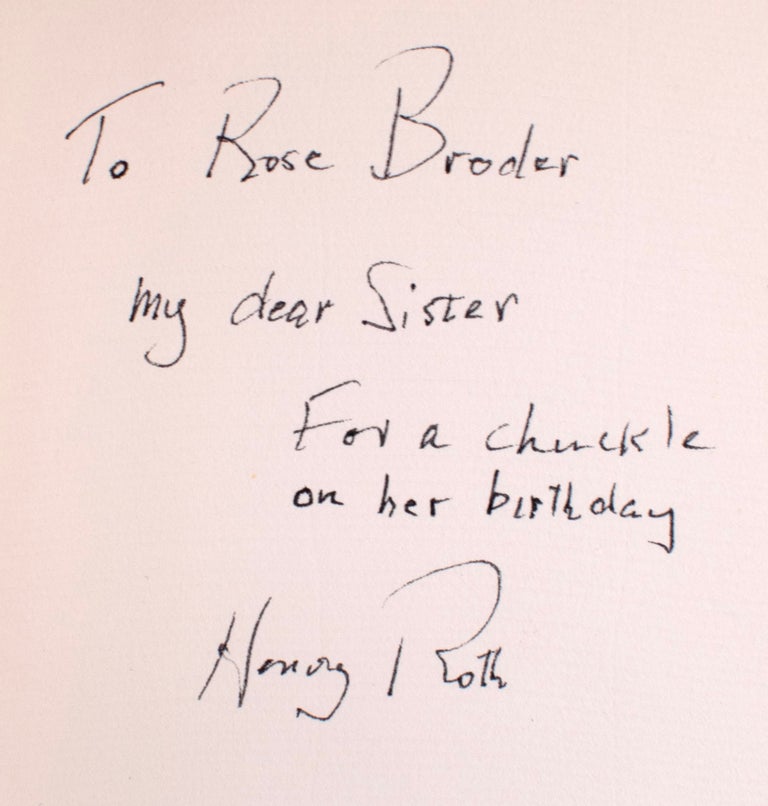

Inscribed to his sister, Rose
Nature's First Green.
New York: Targ Editions, 1979.
Price: $3,500.00
About the item
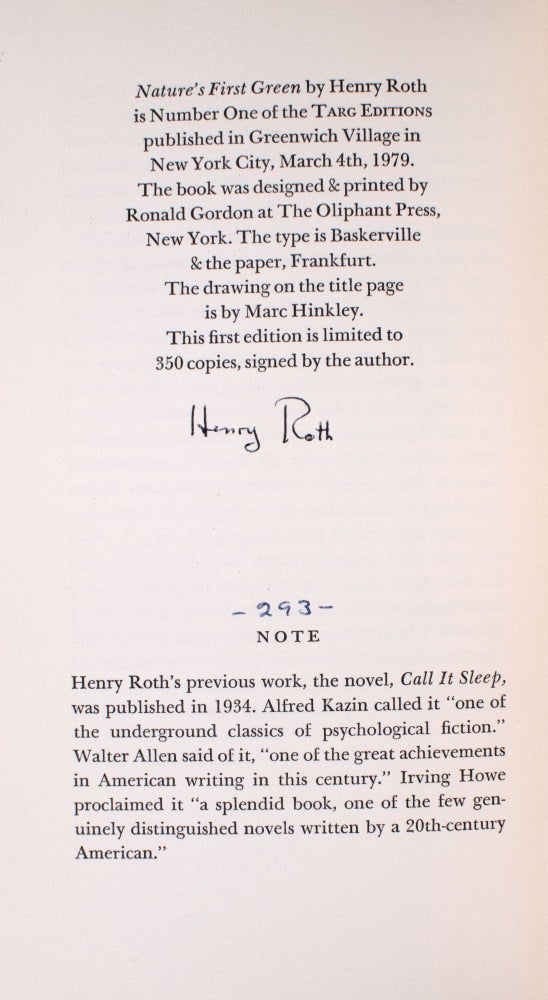
Limited edition, number 293 of 350 copies signed by author. First book in the Targ Editions series. 8vo. Publisher's green cloth; plain yellow dust jacket with some light chipping along top edge. Kellman, Steven, Redemption: The Life of Henry Roth, New York: Norton, 2005.
Item #352736
Additionally signed and inscribed by Roth to his sister: "To Rose Broder / my dear Sister / For a chuckle / on her birthday / Henry Roth"
Henry Roth's masterpiece of NYC ghetto life, Call it Sleep, was written over eight years in blue composition books which were mailed to his sister, Rose, in the city, who obligingly typed them up and mailed them back (Kellman, 113).
Other details about Henry and Rose's relationship only emerged late in his life. Roth began "groping" his sister when he was twelve and she was ten, and four years later they "reached full sexual intimacy" (Kellman, 67). Call it Sleep weaves together so many autobiographical details – about his parents, about the languages in his home, about the gentile slum children he knew, even about sexual relationships with his cousin and other neighborhood girls – but his hero, David Schearl, is an only child. One wonders what Rose made of this omission, in the face of the fact that she would've recognized so much else in the book as the content of her very own upbringing. The full story of their relationship remained a secret until the 1990s; Roth was writing the second volume of his Mercy of a Rude Stream series of autobiographical novels and he introduced a sister character, with whom his hero has an incestuous relationship – she was left out of the first volume, and it's speculated that Roth feared the series wouldn't be published if he included the incest up front in the first volume. Rose Broder (nee Roth), was warned of the content before publication and threatened to sue. This was much reported on at the time, very painfully for all parties involved. Rose was paid $10,000 by Henry and received the legal assurance that sibling incest would not feature in future volumes.
In addition to being excised from Call it Sleep, and typing it up for publication, Rose was instrumental in bringing it back into print again as well. In 1956, she attended a talk about the Jewish American literary canon given by Charles Angoff at a Jewish Community Center in Queens. Angoff mentioned the neglected masterpiece, Call it Sleep, which was out of print, and whose author had disappeared. After the talk Rose spoke to Angoff and offered to put him in touch with her brother, then living in Maine as a poultry farmer. Angoff told Harold Ribalow, a cultural macher and former student of Eda Lou Watson, and Ribalow and Rose Broder set about getting the book out of contractual hock to Scribner's – to whom it was transferred in a deal that was to include a novel that Roth wrote about a charismatic but illiterate union organizer, the manuscript to which he burned the very day he was to give it to Maxwell Perkins. Ribalow and Broder eventually got the book published by Cooper Square Editions, an imprint founded by two booksellers expressly to reprint this book which was regularly fetching more than $100 on the rare book market (Kellman 218-220).
It can be hard to square the torturous past of the Roth sibling's relationship with Rose's clear commitment to her brother's writing. This copy of Nature's First Green is a testament to a more innocent period of their relationship, one in which Henry's writing was still a great source of familial pride.

